
How Arrest Warrants Work in White County
Indiana Code 35-33-2-1 sets the rules for when an arrest warrant issues in White County. After an indictment, the court signs the warrant without a separate probable-cause determination. Charges that begin by information need the probable-cause showing the statute requires. White County publishes no different local issuance rule of its own, so the state code and the signed court record control. Filing venue matters too. White Superior Court is the default criminal venue under the local allocation plan, handling murder, felony, misdemeanor, infraction, ordinance, miscellaneous criminal, expungement, and post-conviction matters. White Circuit Court stays in the picture for juvenile and assigned family matters, where public access may be limited. Only a court finding authorizes custody.
White County Probable Cause Path
In White County, the sequence begins with an indictment or a charging instrument supported through the statutory process. A judge reviews what Indiana law requires. If the warrant is authorized, the written instrument states the offense and directs an arrest. The Sheriff receives it for execution. Service is then returned through court and law-enforcement systems, followed by whatever hearing and bond process the case requires.
- A charging instrument or indictment starts the case.
- The court applies Indiana’s warrant standard.
- The written warrant states its command and bail field.
- The Sheriff or another authorized officer serves it.
- The person enters the required judicial process.
Public sources in White County do not map which deputy, city officer, or marshal serves each order. Confirm a live matter with the issuing court and Sheriff rather than guessing from the investigating agency.
Arrest Warrants: What They Contain
Indiana Code 35-33-2-2 spells out the core written elements. The order must identify the person by name or description, name the offense, give the issue date and county, bear the proper signature, and command that the person be arrested and brought before the court without unnecessary delay. It also carries a bail amount and direction to the county sheriff. No public White County sample involving a private person is needed to explain those fields.
| Identity | Name or sufficient description of the person sought. |
|---|---|
| Offense | The nature of the alleged criminal offense. |
| Issue details | Date, county, and judicial or clerk signature. |
| Command | Direction to arrest and bring the person to court. |
| Bail | The stated amount or court-controlled release term. |
| Service direction | The county sheriff named to execute the order. |
White County Arrest Warrant Checks
Indiana MyCase is the documented public starting point for a case search. Use White Superior court code 91D01 and search by case number when you can. Party searches take name details and can filter by date of birth, court, open-or-closed status, and filing date. MyCase is not the official court record, though, and it warns that information can contain errors or omissions. The White County Sheriff site offers no full public warrant search. Its Most Wanted/Warrants page says to check back later for updates, and an empty program page cannot prove that no arrest warrant exists. For public case information, the warrant event, judge, bond, hearing, and access limits, call the White County Clerk at (574) 583-7032 or White Superior at (574) 583-1548.
How Warrants Get Served in White County
Under Indiana law, the written warrant is directed to the Sheriff. White County Sheriff and Jail is the practical local channel for service, custody, and bond routing. Its published location is 915 Hanawalt Street in Monticello, and its main number is (574) 583-2251. Call before appearing in person. No official source posts a guaranteed walk-in surrender counter, intake hours, accepted identification, booking sequence, magistrate timing, or release timing.
White County Sheriff and Jail
Role: arrest-warrant execution, custody, and confirmed-warrant surrender or bond routing.
Boundary: the Sheriff does not dismiss the charge or replace an order from White Superior or White Circuit.
A city police department or town marshal can take part in a White County investigation or service. The issuing docket still determines the case, hearing, bond, and judicial status.
White County Warrant Access Limits
Some warrant material in White County is simply not public. Arrest-warrant applications, investigative requests, search-warrant records, sealed filings, juvenile matters, and protected identifiers can be excluded under Indiana court access rules. A temporary arrest-warrant exclusion request can also leave a public case screen incomplete while the case moves forward. The official Rule 5 categories lay out the confidentiality and exclusion framework. Those categories explain why no online match is not the same as an official clearance. Ask the record custodian for the public parts of a specific file, and expect lawful redactions or withholding.
Arrest Warrants, Summonses, and Bench Warrants
These documents can all bring a person into court, but they do not start the same way. An arrest warrant authorizes custody after the charging and judicial process. A summons directs a person to appear without first ordering arrest. A bench warrant usually follows a missed hearing, a release-condition problem, or another failure inside an existing case. White County sources use "failure to appear," "bench warrant," and "arrest warrant," not the Texas phrase "capias pro fine."
| Process | Trigger | Immediate effect |
|---|---|---|
| Arrest warrant | Indictment or probable-cause charging process | Authorizes arrest |
| Summons | Court directs an appearance | Requires attendance without an arrest command |
| Bench warrant | Missed court duty or condition | Authorizes arrest in an existing case |
The White County bench warrant lookup addresses the missed-court path in more detail.
White County Arrest Warrant Bond
The White County bond schedule sets out categories with presumptive amounts, but a judge can deviate from any figure and add conditions. A ten-percent cash deposit in the defendant's name on an approved form is one route. So are full cash, a corporate surety bond, a court-approved real-estate property bond, or release on personal recognizance under the governing process. Judges can also hold some cases without bond by order. A published schedule is never a quote for one person's case, so confirm the current order, amount, bond type, and posting route with the court and the White County Sheriff. The Sheriff's bonding page gives no operational instructions. No bond-window hours, online payment vendors, jail payment methods, bondsmen list, or refund timing are published in the public sources. Do not bring funds to any counter until the office confirms the method and location.
Handling an Arrest Warrant in Your Name
Get the details first. Write down the cause number, the court, the warrant event, the judge, any bond entry, and the next setting. From there, a lawyer can reach out to the issuing court, ask for a modified order where that is allowed, and set up a planned surrender or bond. Do not count on an online payment, a phone call, or a walk into the Sheriff's lobby to recall a judicial warrant on its own. White County offers no guaranteed same-day recall or safe-surrender event.
- Check MyCase and identify the issuing White County court.
- Confirm the current public status with the Clerk or court.
- Ask counsel about surrender, bond, and the first hearing.
- Call Sheriff/Jail before traveling to an intake location.
- Follow the written order and attend every later hearing.
- Obtain the updated docket entry after court action.
Act carefully: A confirmed arrest warrant can lead to custody; arrange a lawful court-approved response instead of relying on an old online entry.
Monticello Police and White Warrants
Monticello Police handles city contacts and opens local investigations, but the court-record route for criminal cases in White County still runs through White Superior and the county Clerk. Ask the police a question about a city matter and you will likely be pointed toward the county courthouse. The Monticello Police services page lays out that split. It matters because a payment made at a city counter, or a conversation with an officer, is not a signed recall and not a final warrant-status answer. Local police, county court records, and payment counters each do a distinct job in White County. For an active arrest warrant, confirm the judicial order with the issuing court itself rather than treating a city-office transaction as clearance.
White County Warrants After Service
Once the arrest warrant is served, the hunt for that person ends. The case itself does not. An initial hearing, release terms, counsel decisions, discovery, later hearings, and a final disposition all still lie ahead. Before leaving custody or the courthouse, hold on to the bond or release paperwork and get the next court date in writing. Status language can shift too. A warrant may be returned, served, recalled, modified, or superseded after an online screen was last refreshed in White County. Ask the Clerk or court for the dated docket event, and ask the Sheriff about the service record. MyCase helps with follow-up. When timing matters, though, direct confirmation from the court or clerk remains the sound final step.
White County FTA Consequences
A traffic or ordinance case is not the same as a probable-cause arrest-warrant case, though both can end in an arrest order. Under Indiana Code 9-30-3-8, missing a court date on a traffic matter can bring a warrant and a later notice to the Bureau of Motor Vehicles. Court compliance and the BMV consequence are two separate steps. The Indiana BMV traffic-violation page lays out what happens on the license side after the court issue.
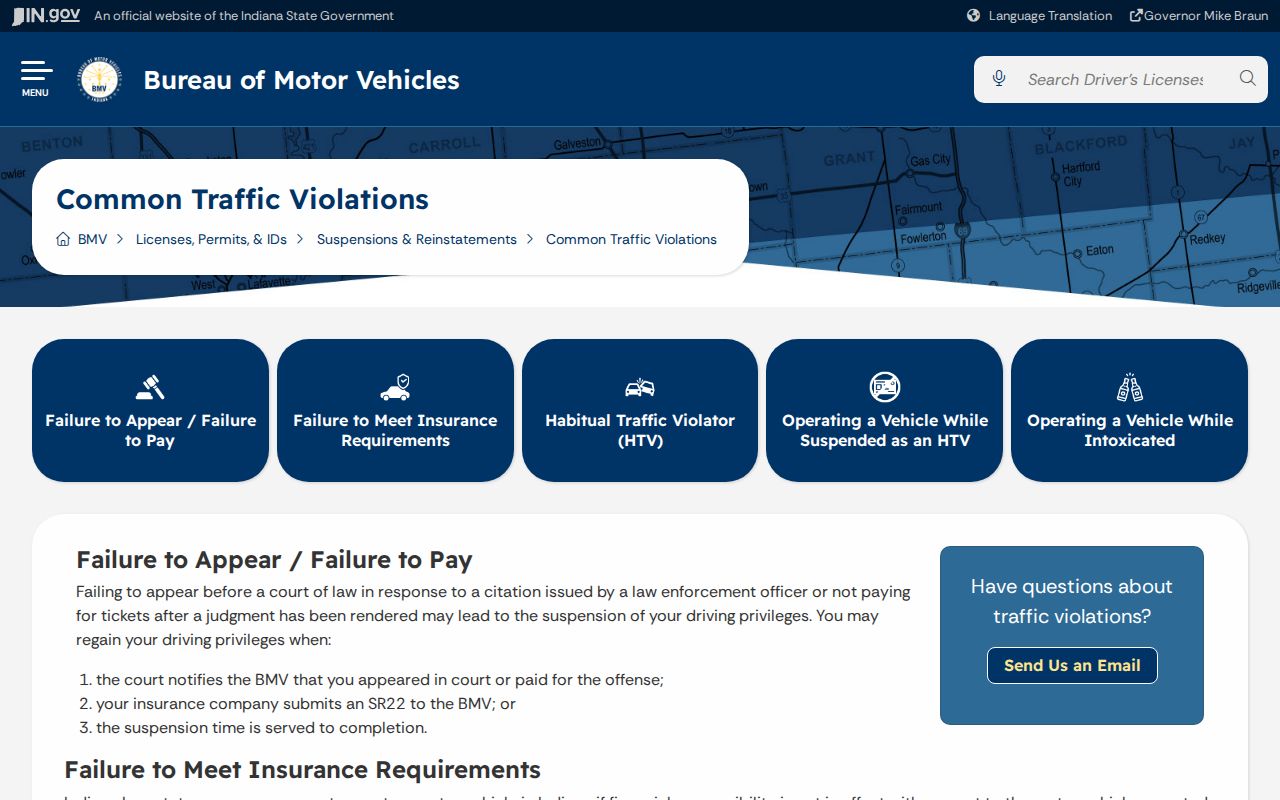
That page separates a court warrant from the license action that may follow. Fix the White County court matter first, then ask the court to send any required compliance notice.
Requesting White County Warrant Records
When a document you want is not online, ask the office that holds it for one narrow record. Give a party name, say whether the case sits in White Superior or White Circuit, add the cause number if you have it, and offer a date range. Name the warrant order, return, bond order, or docket event itself rather than asking for an open-ended background search. The Clerk keeps court records; the Sheriff holds law-enforcement records within its role. Indiana's Access to Public Records Act covers agency records, while Judicial Branch access rules govern court records. Neither route gets past sealed, confidential, juvenile, or investigative restrictions. A records request can show what an agency may release, but it does not create a warrant-status certificate. For urgent personal status, stick with the Clerk, the issuing court, and the Sheriff confirmation chain.
White County Arrest Warrant Confirmation
Write down the date, the office, and the court event you used to confirm a White County warrant's status. A dated Clerk or court response beats an undated screen capture. If service or a recall happened recently, ask when that change should reach the public case display. Keep the signed order with your release and bond papers.
White County Arrest Warrants and Federal Cases
White County court and Sheriff channels cannot answer for federal records. PACER, the federal court, and United States Marshals sources handle those cases. If you cannot tell which jurisdiction issued the warrant, confirm the issuing court first. That one step keeps a federal question away from a county records counter.